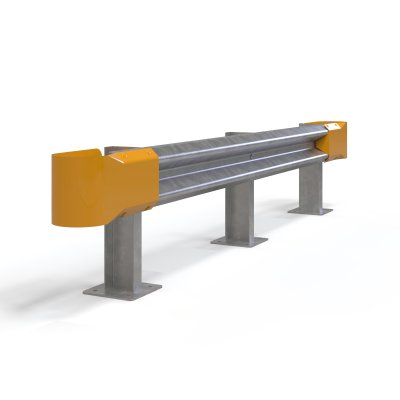
Take a walk through any major logistics yard, loading dock, or commercial hardstand, and you will see it: the heavy-duty, corrugated steel barrier lining the walls and walkways.
In the industry, almost everyone refers to it simply as “Armco.” It is the ultimate industrial guardrail for keeping heavy machinery away from pedestrians and critical infrastructure. But what actually is it, why is it called that, and what is the crucial difference between the barrier on the freeway and the warehouse safety barrier inside your facility?
Why is it called “Armco”?
Calling a steel guardrail “Armco” is exactly like calling a tissue a “Kleenex” or a vacuum cleaner a “Hoover.” It is a brand name that became so dominant it turned into the generic term for the product.
In the early 1930s, the American Rolling Mill Company (ARMCO) pioneered the W-beam corrugated steel crash barrier. Before that, highway barriers were often just wood or rigid stone, which were deadly in a crash. Their steel W-beam design was revolutionary, and because they supplied it to almost every major infrastructure project for decades, the name stuck. Today, whether the steel is manufactured by that original company or not, the industrial world still calls it an Armco barrier.
Highway vs. Industrial Guardrail: The Critical Difference
While they might look identical at a glance, there is a massive engineering and legal difference between the guardrail on the side of a public highway and the guardrail installed in a commercial yard.
Highway-rated guardrails are heavily engineered for high-speed impacts. They are designed to absorb kinetic energy, crumple in a specific way, and deflect a speeding vehicle along the barrier rather than stopping it dead. They require complex, crash-tested end terminals and strict regulatory compliance (such as MASH ratings) approved by road agencies.
Industrial (Off-Highway) guardrails, like the systems we supply at MAD Safety, are entirely different beasts. They are designed for low-speed, high-mass impacts—specifically from forklifts, delivery trucks, and heavy warehouse equipment. They are designed to be rigid, creating a solid physical stop to prevent machinery from penetrating pedestrian zones or smashing into building walls.
Note: Our corrugated guardrail systems are engineered strictly for off-highway, industrial, and commercial use. They are not rated for use on public roads or highways.
Australian Standards & WHS Compliance
When it comes to compliance, installing an industrial guardrail isn’t just a suggestion – it is a core part of meeting your obligations under Safe Work Australia’s Traffic Management guidelines.
If you have forklifts and pedestrians sharing a workspace, WHS legislation demands that you provide a safe working environment, and physical segregation is the primary control measure. When assessing the strength of these physical barriers, engineers look to AS/NZS 1170.1 (Structural Design Actions). This Australian Standard outlines the specific impact forces and structural loads a barrier must be able to withstand to ensure it actually stops a forklift, rather than just bending under the weight.
Where Should You Use Industrial Guardrails?
A painted yellow line on a concrete floor will not stop a three-tonne forklift. If you want true forklift pedestrian segregation and asset protection, you need physical steel. Here are the three most critical areas to install it:
- The Loading Dock
Loading docks are high-risk zones where heavy transport vehicles are constantly reversing in tight spaces. Installing guardrails along the dock approach prevents drivers from backing into critical building infrastructure, downpipes, or adjacent structures if they misjudge their angle. - Warehouse Pedestrian Walkways
If you have staff walking through a facility where forklifts are operating, physical segregation is a non-negotiable safety requirement. A continuous run of corrugated guardrail creates an impenetrable wall between your heavy machinery and your personnel, ensuring that a momentary lapse in driver concentration doesn’t result in a fatal incident. - Hardstand Areas & Asset Protection
Every commercial yard has expensive, exposed infrastructure: electrical switchboards, water tanks, structural columns, and expensive insulated building panels. Surrounding these high-value assets with off-highway guardrail ensures that a minor parking error by a delivery driver doesn’t result in tens of thousands of dollars in operational downtime.
If you are relying on painted lines and good luck to separate your heavy machinery from your staff and your building assets, it’s time to upgrade to physical steel.
Protect your people and your property today with our heavy-duty, off-highway corrugated guardrail systems. View the specs and order direct at madsafety.co.